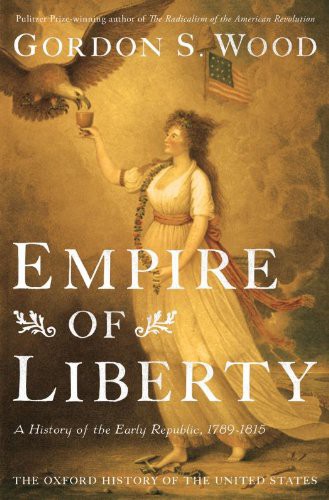
Empire of Liberty: A History of the Early Republic, 1789-1815
Autor: Gordon S. Wood
Tema: History & Theory; United States - Civilization - 1783-1865; General; United States; #genre; United States - Politics and Government - 1789-1815; Political Science; Revolutionary Period (1775-1800); 19th Century; History
Editorial: Oxford University Press (2009-10-10)
22c0882b-df42-4e75-b
Amazon.com Review
Take a Look Inside the Empire of Liberty [Click on Images to Enlarge]
George Washington (1732–1799): This portrait painted by Gilbert Stuart in 1797 was the one rescued by Dolley Madison in 1814 when the British burned the White House.
(Library of Congress)
Lyon-Griswold Brawl (1798): Outraged by this brawl on the floor of the House of Representatives, many concluded that Congress had become contemptible in the eyes of all “polite or genteel†societies. (Library of Congress)
Washington, D.C. in 1801: The nation’s capital remained for years primitive and desolate, with muddy streets, a swampy climate, and unfinished government buildings that stood like Greek temples in a deserted ancient city. (Library of Congress)
Capture of the City of Washington: In 1814 the British army set fire to many public buildings here. Although this was considered a violation of the laws of war, they were probably retaliating for the Americans’ burning of buildings in the Canadian capital, York (Toronto). (Library of Congress)
Shakers: The name “Shakers†was originally pejorative, mocking the religious group’s rituals of trembling, dancing, and shaking. Their commitment to celibacy kept a rigid separation of the sexes, even in dancing, as this illustration shows. (Library of Congress)
From Publishers Weekly
Starred Review. A new addition to the Oxford History of the United States, Wood's superb book brings together much of what historians now know about the first quarter-century of the nation's history under the Constitution. Acknowledged as the leading historian of the period, Wood brings authority and easy style to a tough task—wrestling into order a period of unusual anxiety, confusion, crisis and unbridled growth in the nation's affairs. The emergence of democracy and individualism is his overarching theme. No surprise there, for he's the author of a celebrated work (The Radicalism of the American Revolution) on just that topic. In this new work, he concentrates more on events, institutions, politics and diplomacy than in his earlier books yet proves himself a master of these topics, too. He offers no newfangled approaches, no strongly stated positions, no contests with other historians. Instead, we get the distillation of a lifetime's study and reflection about the era between Washington's presidency and the end of the War of 1812. A triumph of the historian's art, Wood's book will not soon be supplanted. No one interested in the era should miss it. 40 b&w illus., maps. (Oct.)
Copyright © Reed Business Information, a division of Reed Elsevier Inc. All rights reserved.