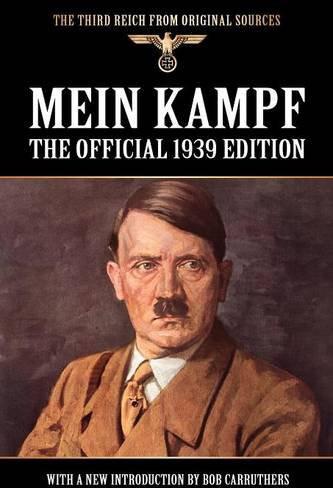
Mein Kampf - the Official 1939 Edition
Author: Bob Carruthers
Subject: Political Ideologies; World War II; Historical; Fascism & Totalitarianism; Holocaust; Political Science; Biography & Autobiography; Military; History
Publisher: Coda Books Limited (2012-10-26)
d322c8a0-da40-496d-8
Amazon.com Review
The angry ranting of an obscure, small-party politician, the first volume of Mein Kampf was virtually ignored when it was originally published in 1925. Likewise the second volume, which appeared in 1926. The book details Hitler's childhood, the "betrayal" of Germany in World War I, the desire for revenge against France, the need for lebensraum for the German people, and the means by which the National Socialist party can gain power. It also includes Hitler's racist agenda and his glorification of the "Aryan" race. The few outside the Nazi party who read it dismissed it as nonsense, not believing that anyone could--or would--carry out its radical, terrorist programs. As Hitler and the Nazis gained power, first party members and then the general public were pressured to buy the book. By the time Hitler became chancellor of the Third Reich in 1933, the book stood atop the German bestseller lists. Had the book been taken seriously when it was first published, perhaps the 20th century would have been very different.
Beyond the anger, hatred, bigotry, and self-aggrandizing, Mein Kampf is saddled with tortured prose, meandering narrative, and tangled metaphors (one person was described as "a thorn in the eyes of venal officials"). That said, it is an incredibly important book. It is foolish to think that the Holocaust could not happen again, especially if World War II and its horrors are forgotten. As an Amazon.com reader has pointed out, "If you want to learn about why the Holocaust happened, you can't avoid reading the words of the man who was most responsible for it happening." Mein Kampf, therefore, must be read as a reminder that evil can all too easily grow. --Sunny Delaney
Review
The angry ranting of an obscure, small-party politician, the first volume of Mein Kampf was virtually ignored when it was originally published in 1925. Likewise the second volume, which appeared in 1926. The book details Hitler's childhood, the "betrayal" of Germany in World War I, the desire for revenge against France, the need for lebensraum for the German people, and the means by which the National Socialist party can gain power. It also includes Hitler's racist agenda and his glorification of the "Aryan" race. The few outside the Nazi party who read it dismissed it as nonsense, not believing that anyone could--or would--carry out its radical, terrorist programs. As Hitler and the Nazis gained power, first party members and then the general public were pressured to buy the book. By the time Hitler became chancellor of the Third Reich in 1933, the book stood atop the German bestseller lists. Had the book been taken seriously when it was first published, perhaps the 20th century would have been very different.
Beyond the anger, hatred, bigotry, and self-aggrandizing, Mein Kampf is saddled with tortured prose, meandering narrative, and tangled metaphors (one person was described as "a thorn in the eyes of venal officials"). That said, it is an incredibly important book. It is foolish to think that the Holocaust could not happen again, especially if World War II and its horrors are forgotten. As an Amazon.com reader has pointed out, "If you want to learn about why the Holocaust happened, you can't avoid reading the words of the man who was most responsible for it happening." Mein Kampf, therefore, must be read as a reminder that evil can all too easily grow.
(Amazon.com Review -Sunny Delaney )
This is the big sensation of the month, and all eyes are on the legal battle over the two editions. It is not within our province to pass judgment on the case. We simply wish to announce the distinguishing features of the two books, both complete, unabridged editions of the most discussed book in the world today. Reynal & Hitchcock, in conjunction with Houghton, Mifflin, are issuing their translation by Dr. Alvin Johnson, with careful annotations by eminent scholars and publicists. The details are laid forth in the February 4th P.W., including the publishers' statement in regard to the matter of royalties to Germany and profits to the refugees. The promotion plans are also outlined, and the advance sale indicates that it will be possible to back the publication with a tremendous nation-wide advertising campaign. Publication set for early March. Price $3.00 .... Suit has been brought against Stackpole and due warning issued by Houghton, Mifflin. The fact that no royalties are being paid to Hitler has resulted in a big advance on this Stackpole edition, a translation by Barrows Mussey. (Kirkus Reviews )